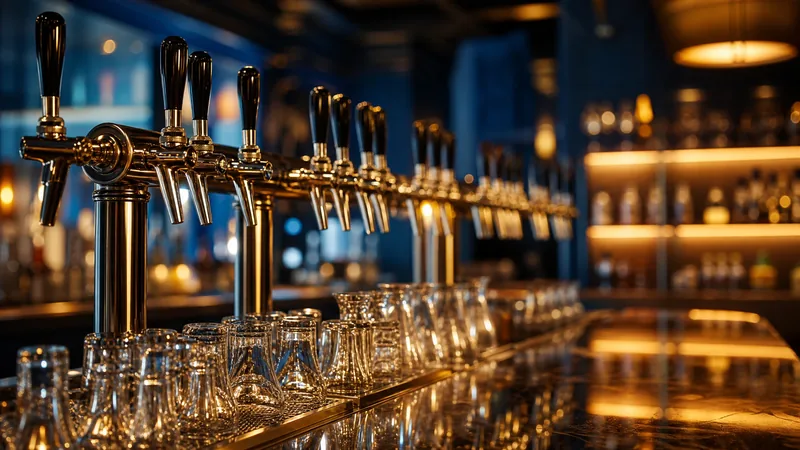
How to Start a Bar or Liquor Store in Delaware: Alcoholic Beverage Control Licenses, $1,000 Biennial for Restaurants and Package Stores and $500 for Beer-Only Taverns
How to Start a Bar or Liquor Store in Delaware: Alcoholic Beverage Control Licenses, $1,000 Biennial for Restaurants and Package Stores and $500 for Beer-Only Taverns
Opening a bar, liquor store, or other alcohol-serving establishment in Delaware requires navigating state-level Alcoholic Beverage Control (ABC) licensing and local municipal approval. Delaware's licensing framework is straightforward compared to many states, but it involves multiple layers: forming your business entity, registering with the state, obtaining a general business license, and securing specific ABC authorization. This guide walks you through each requirement, the actual costs you will pay, and the compliance obligations that follow.
What You Will Need to Get Started
Before you apply for your ABC license, gather the following materials and documentation:
- Proof of business entity formation. You will need a Certificate of Formation (for an LLC) or Certificate of Incorporation (for a corporation) filed with the Delaware Division of Corporations. If you have not formed an entity yet, plan for this step first.
- Trade name registration (DBA) documentation. If you operate under a name other than your legal entity name, you will need a registered trade name filed with the Delaware Division of Revenue through Delaware One Stop. Registration is $25, one-time, statewide.
- Active state business license. Every Delaware business needs a business license from the Division of Revenue, applied for through Delaware One Stop. The license fee is $75 a year for most categories and $90 for retailers. Gross receipts tax is separate and set by category: restaurants and contractors pay 0.6472%, and retailers pay 0.7468%. (Delaware has no sales tax; instead, you report and pay a monthly or quarterly gross receipts tax.)
- Proof of a registered agent with a Delaware address. Every Delaware entity must maintain a registered agent with a physical street address in Delaware. If you are not registered in Delaware, you will need to appoint one (a Delaware resident, a business entity, or a professional registered agent service).
- Personal identification and ownership information. The ABC Commissioner will require background information for all owners, officers, and managers. Prepare personal information, addresses, and identification for all principals.
- Proof of location and zoning compliance. You will need the address of your establishment and proof that it complies with local zoning. Some municipalities have distance restrictions from schools, residential areas, or other bars, or may limit the number of licenses. Check with your town before committing to a location.
- Responsible server training certification. Employees who serve alcohol for on-premises consumption, and the managers of those employees, must complete a Commissioner-approved responsible server training program, and a licensee who helps manage the business must complete it too. On-premises applicants certify this on the application. Certification is valid for 2 years.
- Financial and ownership documentation. The ABC office may request bank statements, ownership structure, and proof of financial viability, depending on the type of license you are seeking.
Numbered Steps to Obtain Your Delaware Liquor License
Step 1: Choose Your Business Structure
Decide whether you will form an LLC or a corporation. An LLC filed in Delaware costs $110 and owes a flat annual tax of $400 due each June 1 (starting in 2027 for the first payment; check corp.delaware.gov for the current amount and date). A corporation costs $109 to file and must file an Annual Franchise Tax Report and pay the associated fee by March 1 each year. For most small bars and liquor stores, an LLC is simpler. You can form your entity online through the Delaware Division of Corporations at https://icis.corp.delaware.gov/ecorp2.
Step 2: Form Your Delaware Entity or Register as a Foreign Entity
File your Certificate of Formation (for an LLC) or Certificate of Incorporation (for a corporation) with the Delaware Division of Corporations. You can file online via the eCorp Document Upload Service. Processing times vary with volume; expedited options are available for an additional fee ($50 for 24 hours or next business day, up to $1,000 for one-hour service). Once your entity is formed, you will receive your file-stamped certificate. Keep this document; you will need it for your ABC application.
Step 3: Register a Trade Name (DBA) if Needed
If you plan to do business under a name different from your legal entity name (for example, operating "The Red Door Bar" while your LLC is "RD Holdings LLC"), you must register a trade name (also called a DBA or fictitious name) with the Delaware Division of Revenue. Register through Delaware One Stop at https://onestop.delaware.gov. The fee is $25, one-time. The registration does not expire and does not require renewal. Note: registering a trade name requires that you already have an active business license, so complete Step 4 first.
Step 4: Obtain Your Delaware State Business License
Apply for a business license from the Delaware Division of Revenue through Delaware One Stop. For a bar or restaurant, select the "Restaurants and Contractors" category. For a package store (off-premises liquor sales), select "Retail." The license fee varies by category: restaurants and contractors pay $75 annually (or $225 for three years), and retail stores pay $90 annually (or $270 for three years). If you have multiple locations, each additional location costs $25. A one-year license is prorated by full calendar months for the first year, then renews December 31. Processing times vary, so check with the Division of Revenue. Once you have your business license number, you can register your trade name if needed.
Step 5: Understand Your ABC License Category
The Alcoholic Beverage Control Commissioner issues different license types depending on what you plan to sell and whether sales are on-premises (customers drink on your property) or off-premises (customers take alcohol away, like a package store). Biennial fee categories are:
- On-premises (Bars, Restaurants, Taprooms): Restaurant or hotel with all liquor, $1,000 biennial. Restaurant beer and wine only, $500 biennial. Tavern beer only, $500 biennial. Taproom (brewery or cidery), $1,000 biennial. Cabaret, $2,000 biennial. Beer garden, $2,000 biennial.
- Off-premises (Package Stores, Online): Package store (liquor, beer, wine, cider), $1,000 biennial. Third-party delivery (delivery service), $1,000 biennial.
- Special Licenses: Caterer (on-premises), $1,000 biennial; off-site caterer, $500 biennial. Club (members-only), $300 biennial under 400 members, $600 biennial for 400 or more. Bottle club, $300 biennial. Tasting permit, $150 biennial. Patio permit, $1,000 biennial.
Most on-premises and off-premises retail licenses also pay an extra $100 per year to the Overservice Investigation Fund. If your application requires staff background investigation or a hearing, you will pay a non-refundable $1,000 application process fee (of which $600 goes to the responsible server training fund). Check with the ABC Commissioner regarding any restrictions on holding multiple package store licenses; the law was rewritten effective October 21, 2026, and limits apply.
Step 6: Prepare and Submit Your ABC Application
Contact the Office of the Alcoholic Beverage Control Commissioner to request an application form. Provide all required information: your legal entity name and formation documents, the address of your establishment, a description of your business type and what you will sell, names and background information for all owners and managers, your registered agent information, and your location's zoning compliance. The ABC office will review your application for completeness and may schedule a hearing if required by statute or if there are objections from the public or local government.
Step 7: Attend Your ABC Hearing (if Required)
The ABC Commissioner will notify you if a hearing is required. Not all applications need a hearing, but you should be prepared to attend and answer questions about your business plan, your qualifications, how you plan to prevent overservice and illegal sales to minors, and your financial ability to operate responsibly. Bring documents to support your application. The Commissioner will decide whether to issue, deny, or place conditions on your license.
Step 8: Complete Responsible Server Training
Employees who serve alcohol for on-premises consumption, and their managers, must complete a responsible server training course approved by the Commissioner, and a licensee who participates in management must complete it as well. On-premises applicants certify this on the application. The course covers recognizing signs of intoxication, checking identification, refusing service, and understanding the laws. Certification is valid for 2 years, after which renewal training is required. Save your certificate; you may need to show it on request.
Step 9: Check Local and Municipal Requirements
Delaware has 3 counties and 57 incorporated places. Many municipalities impose additional licensing, zoning, hours-of-operation, or distance requirements. Some beach towns have their own rules. Contact your town or city clerk's office to confirm whether local approval, a local license, or a public hearing is required. Some towns require proof of ABC approval before they will issue a local license; others issue local approval before you seek the state license. Verify the sequence in your municipality.
Step 10: Receive Your License and Begin Operations
Once the ABC Commissioner approves your application and you have met all requirements, you will receive your license. The license runs for a two-year term, and the Commissioner sets the exact dates. Display it on your premises as required. All licenses run two years, and the fee is prorated at 1/24 of the biennial fee per month if you are seeking a partial term.
Tips and Common Mistakes to Avoid
- Do not skip the business license. Every Delaware business needs its general business license from the Division of Revenue, separate from the ABC license. Operating without one carries a fine of up to $3,000 or up to two years in prison (30 Del. C. 2119).
- Check municipal rules early. Some towns have strict distance requirements from schools or residential areas, or limits on the number of licenses they allow. If you choose a location without confirming local zoning and approval, you may invest time and money on an application that cannot be approved. Call your town clerk before you sign a lease.
- Understand your license category. The difference between a beer-only tavern ($500 biennial) and a full-liquor restaurant ($1,000 biennial) is significant. Decide what you will sell and apply for the correct license type. If you later want to expand (for example, add wine to a beer-only license), you will need to apply for a new license or an amendment.
- Budget for the Overservice Investigation Fund fee. Most on-premises and off-premises retail licenses include a $100 annual fee. This is in addition to the biennial license fee. Do not be surprised by this cost at renewal.
- Plan for responsible server training. On-premises applicants must certify on the application that servers and their managers have completed the training. Complete this requirement as soon as you know you will open a location.
- Verify your registered agent is compliant. Your registered agent must have a physical street address in Delaware (no PO boxes). If you are using a registered agent service, confirm they are active and in good standing.
- Know the difference between a DBA and your entity name. You can operate your bar under a trade name, but the ABC license is issued to your legal entity.
- Do not assume all liquor stores are the same license. Off-premises package store licenses are limited under Delaware law: one person may hold or have an interest in only a limited number (rewritten effective October 21, 2026). If you plan to open multiple stores, consult the ABC Commissioner before you invest in applications.
- Clarify processing times with the ABC office. The Division of Alcohol, Tobacco, and Marijuana Enforcement does not publish standard turnaround times for license applications. Timing depends on whether a hearing is required and whether you need to provide additional information. Ask the ABC office for a timeline estimate when you submit your application.
Expected Results
If you follow these steps and meet all requirements, you can expect to receive an ABC license within the timeframe provided by the ABC Commissioner's office. Upon approval, you will be authorized to sell and serve the types and quantities of alcohol specified in your license on your licensed premises. Your license is valid for two years. You will be subject to compliance inspections to ensure you are not serving minors, are not operating beyond your licensed capacity, and are not violating hours of operation or other conditions imposed by the Commissioner. Violations can result in fines, suspension, or revocation. You will also owe the gross receipts tax on your alcohol sales, reported monthly or quarterly to the Delaware Division of Revenue. For restaurants and bars, the tax rate is 0.6472% of gross receipts. Off-premises retail sales of liquor, beer, cider, and wine are exempt from the retailer gross receipts rate (30 Del. C. 2909(c)); check with the Division of Revenue for how your package store is classified. As of 2026, licensed liquor stores may also sell state-endorsed THC-infused beverages if they meet additional requirements; check with the Office of the Marijuana Commissioner for current rules.
Additional Considerations
The ABC licensing rules in Delaware, codified in 4 Delaware Code Chapter 5, are subject to amendment. A new version of Section 554 (which sets license fees and categories) takes effect January 23, 2027. Current fees and categories apply until that date. Before you invest in an application, check the ABC Commissioner's website or call the office to confirm that the fees and license types described here are still current.
If you are forming a corporation, note that you must file an Annual Franchise Tax Report by March 1 each year and pay the associated franchise tax. If you are forming an LLC, you owe an annual tax of $400 due June 1 each year (starting June 1, 2027; confirm the current amount at https://corp.delaware.gov). These entity-level taxes are separate from your ABC license fees and your business gross receipts tax.
Delaware offers no seller's permit or sales tax exemption because there is no state sales tax. You will not be selling items subject to sales tax, but you will be reporting gross receipts. Understand your tax category and file accordingly with the Division of Revenue.
Disclaimer
This article is informational and is not legal or tax advice. Alcoholic beverage licensing is complex, and rules vary significantly by municipality. Before you proceed, consult a Delaware business attorney and a CPA familiar with alcohol licensing and gross receipts tax to ensure you understand your obligations and that your business structure is appropriate for your goals. Contact the Delaware Division of Corporations (https://corp.delaware.gov), the Delaware Division of Revenue (https://revenue.delaware.gov), the Office of the Alcoholic Beverage Control Commissioner, and your local town or city government directly to confirm all current fees, requirements, and timelines.
Keep exploring: related Delaware guides
- How to Start a Bakery Business in Delaware
- How to Start a Brewery, Distillery or Winery in Delaware
- How to Start a Restaurant in Delaware
- How to Start a Catering Business in Delaware
- How to Start an LLC in Delaware
- Delaware Business License
- How Much Does It Cost to Start a Business in Delaware
- All Delaware business types
- Every Delaware guide in one place